Why Beaches Often Form in Bands
Why beaches form in bands: understand how waves, sediment and shore shape arrange sand and shingle, and why those patterns vary from beach to beach.
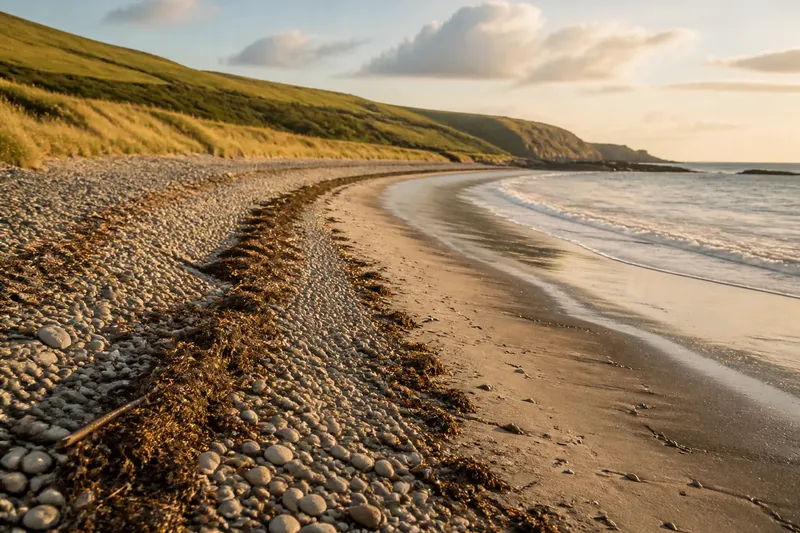
Beaches often form in bands because waves sort and move sediment differently across the shore. The visible result may be a strip of coarse shingle near the water, finer sand farther up, or several ridges and hollows running roughly parallel to the water’s edge. Why beaches form in bands depends on the material available, the shape of the coast and the waves that reach it; no single pattern describes every beach.
What does a beach band mean?
A beach band is a recognisable zone of sediment or a raised strip of beach, usually aligned broadly along the shoreline. The word describes an appearance, not a formal boundary that every beach must contain. A band may be distinguished by grain size, colour, elevation, dampness or the way it slopes.
For instance, pale sand may sit below a darker line of seaweed and driftwood, while rounded pebbles form a ridge above it. These features do not necessarily share the same origin. A ridge is a shape in the beach surface; a colour change may simply mark where wet and dry material meet.
Several useful terms help describe what is visible:
- Foreshore: the part of the beach between the usual low- and high-water limits, covered and exposed as the tide changes.
- Backshore: the upper part, generally reached by waves during higher tides or more energetic conditions.
- Beach ridge: a raised strip of sediment, often roughly parallel to the shoreline.
- Swash: water moving up the beach after a wave breaks.
- Backwash: water draining back down towards the sea.
- Shingle: a loose accumulation of coarse pebbles or small stones; usage can vary by place.
These labels are descriptive. They do not mean that a beach has sharply divided zones, or that its bands stay in one place. The edge between sand and shingle may be uneven, and a later tide can blur it.
How do waves sort sand and shingle?
Waves sort sediment by moving grains and stones, with the result shaped by their size, weight and the water’s movement. When swash carries material up a slope, larger, heavier pieces may be left higher if the water loses strength. Finer grains are easier to shift and may be carried back down by draining water or moved along the shore by currents.
That is a tendency, not a dependable rule for every wave. A strong backwash can pull coarse material downslope, and a powerful wave can carry large stones higher than calmer water would. The same shore can show a different arrangement after a change in wave direction or energy.
Think of a kitchen sieve, though the beach has no neat mesh and the water is not obliging. A sieve separates pieces according to size; waves sort material through repeated movement, while slope, water depth and grain shape complicate the result. Rounded pebbles, flat cobbles and angular fragments do not travel in quite the same fashion.
Where sand and shingle meet, their boundary may reflect repeated sorting rather than a single event. The line can sharpen when waves repeatedly move the finer grains away from a coarse deposit. It may soften when fresh sand arrives or when changing water reaches across both materials.
Why do ridges and hollows run along the shore?
Ridges and hollows can develop as waves push sediment landwards and water drains back, building and reshaping the beach surface. A ridge is often followed by a lower trough on its seaward side. Multiple ridges can record repeated movement, but their form alone does not reveal a precise history.
Some ridges lie close to the water; others sit higher on the beach. The position depends partly on which waves reach that part of the shore. Ordinary wave action may shape lower features, while more energetic conditions can move material beyond the usual reach of the tide and leave a higher ridge.
On a gently sloping shore, the water spreads across a broad area, so changes in sediment may appear as wide zones. A steeper beach concentrates the change over less horizontal distance. Its bands may look more abrupt, though the underlying material can still vary gradually.
Not every visible ridge is a stable feature. A storm can flatten one, cut a notch into another, or shift sediment into a new line. The beach’s surface is a record of movement, but not a timetable with each mark neatly dated.
Why do bands differ from beach to beach?
Each beach has its own supply of sediment, exposure to waves and shape. A sheltered cove may receive finer material that settles in quieter water. An exposed coast may have coarse stones left behind as smaller particles are carried away. Nearby beaches can differ because headlands, offshore bars or river mouths alter the route sediment takes.
Grain shape and source matter too. A beach supplied by a river may contain a mix of sand and gravel washed from inland. Material eroded from local cliffs can produce a different blend, while shells and fragments of marine organisms may contribute pale grains. The mix changes as sediment is added, removed or moved along the coast.
Shore shape influences how those materials are arranged. A bay can shelter its centre from some wave directions while leaving its ends more exposed. A narrow inlet may channel water and sediment differently from an open strand. Even the orientation of the coast affects which waves arrive directly and which approach at an angle.
Human changes can also affect sediment movement. Sea walls, groynes and dredging may alter where material is retained or transported. Their effects depend on local conditions, so a band seen beside a structure is not, by itself, proof of what caused it.
What can a beach band tell you?
A band can offer clues about sediment size, recent water reach and the direction in which material has been moving. It is more reliable as a description of what is visible now than as a complete account of how the beach formed. A line of driftwood, for example, can mark where waves carried floating debris, but it does not necessarily mark the highest reach of every wave.
Look for several features together rather than reading one line in isolation. Note whether the beach rises steeply or gently, whether the upper surface is dry or damp, and whether the band consists of sand, pebbles or mixed material. Compare the pattern along the shore, where a change in exposure may be evident.
Say you arrive at a fictional cove where a narrow strip of rounded shingle sits above damp sand. If you notice a low ridge beside the shingle and a broad, shallow slope below it, you might infer that waves have sorted the material and shaped a raised line. The sensible observation is that the two materials and the ridge occupy different zones; identifying the exact wave event that formed them would require more evidence.
What questions do people ask about beach bands?
Does every beach have bands?
No. Some beaches have a fairly uniform surface, while others show clear changes in material or elevation. Bands may also be subtle, irregular or temporarily obscured by water and recent sediment movement.
Why is the sand wet in one band and dry in another?
Water drains through and over the beach, so lower areas are more often reached by waves and may remain damp. The boundary shifts with the tide, recent wave reach, rainfall and how readily the sediment drains.
Are parallel ridges old high-tide marks?
They can reflect earlier wave activity, but a ridge is not automatically a high-tide mark. Wave energy, beach slope and sediment supply all affect where material is deposited, and several processes may have shaped the same feature.
Why do pebbles sit above the sand?
Waves may leave heavier pebbles higher as swash loses strength, while finer sand is carried back or shifted along the beach. The arrangement can also reflect differences in sediment supply and exposure, and it may change as conditions change.
How should you describe a band without overclaiming?
Describe what you can see before suggesting why it formed. “A coarse pebble ridge above damp sand” is more precise than “the storm line” unless there is a clear basis for that interpretation. Record where the band sits, what it contains and whether it continues along the shore or breaks into patches.
Why beaches form in bands is best answered by combining three observations: the waves that move the sediment, the material available to be moved and the shore shape that receives it. A band is a useful clue, not a label for a universal beach pattern. On the next visit, notice where the coarse grains end and the finer ones begin; that boundary says something about the local shore, even when it does not tell the whole story.