Quay or Pier: Two Different Jobs at the Water’s Edge
Quay or pier: identify each harbour structure by its layout, access and working role, even when local names blur the distinction.
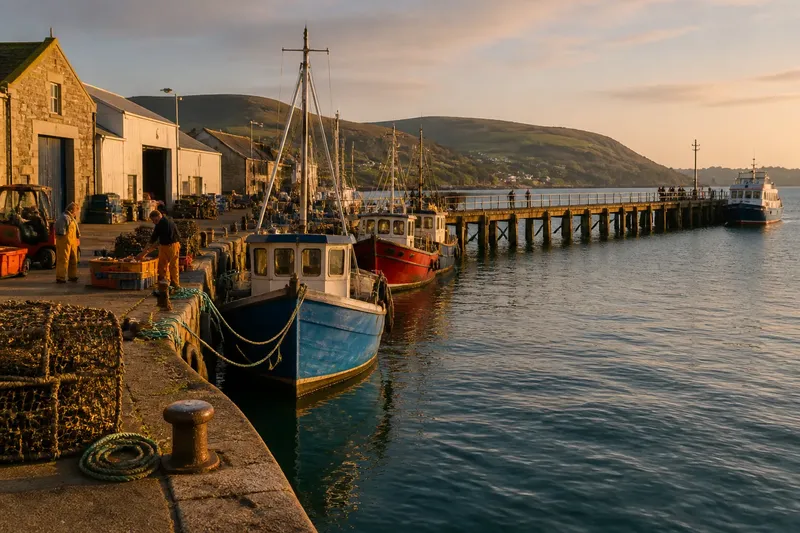
Quay or pier is easier to judge by following the movement each structure serves than by reading its name. A harbour wall can carry a promenade, and a projecting landing can handle working boats, so purpose and layout matter more than the label painted on a sign.
What work does a quay make possible?
A quay is a built edge where vessels berth alongside land. Behind it there may be a paved apron, road, warehouse or yard, allowing people and goods to move between boat and shore without a separate walkway across the water.
At a fishing harbour, the quay may be where crews bring gear ashore and move their catch towards storage or a market. In a larger port, the same shore-parallel arrangement can serve cargo handling or passenger access. The common feature is the close connection between the berth and the land behind it.
Bollards, fenders, ladders and mooring rings can help identify a working berth, but their absence proves little. A modest quay may have few visible fittings, while a former commercial edge may now be used mainly by pedestrians.
What does a pier connect?
A pier extends from the shoreline over the water. It may rest on piles, stand as a solid structure or use another form suited to its setting. Its defining quality is the route it creates away from the shore.
A pier can provide a landing place, carry a path for visitors or let vessels berth beyond shallow water near the coast. Some are working structures; others are chiefly used for walking, fishing or reaching a passenger boat. The outline alone does not settle the purpose.
Think of a quay as a bench running along a wall and a pier as a narrow board reaching out from it. The comparison is only about direction: real harbour structures are built for loads, water and vessels, not for making furniture analogies look clever.
How can you tell a quay from a pier at a glance?
Trace the structure’s main line against the shore, then look at how people and boats reach it. These observations lead to a useful first decision, though a mixed-use harbour may not fit a neat label.
- Direction: If the structure runs parallel to the waterfront, treat it as a likely quay; if it projects across the water’s edge, consider a pier, then check its use.
- Space behind the berth: If a road, yard or paved apron meets the water directly, read the edge as a quay; if open water lies on both sides of a route, consider a pier.
- Pedestrian access: If a path leads visitors out over the water, treat that as evidence of a pier-like layout; if the route follows the waterfront, consider a quay instead.
- Boat position: If vessels lie along a shore-parallel wall, consider a quay; if they berth alongside an outward-reaching platform, consider a pier.
- Working signs: If you see mooring fittings and a loading area connected to land, consider a working quay; if the structure mainly serves visitors, call it a public pier only if its shape also projects offshore.
- Wave shelter: If the structure’s apparent main role is to reduce wave exposure at a harbour entrance, consider a breakwater rather than a quay or pier; if it also provides berthing, describe both functions.
No single observation decides every case. A quay can be open to walkers, and a pier can handle cargo; use the shape and the activity together rather than treating either as a rule.
Why do harbour terms overlap?
Harbour names come from local usage as well as physical form. A projecting landing stage may be called a quay locally, while a pier may have a substantial commercial role. An old name can remain in place after a structure’s work changes.
Nearby terms help, but they are not interchangeable everywhere. A jetty often projects into water for navigation, access or protection. A breakwater is chiefly intended to shelter a harbour from waves, and may not be a landing place. A wharf can mean a waterside platform or the broader loading area and buildings around it.
When the naming is unclear, describe what is visible: a shore-parallel berthing wall, an outward-reaching landing, or a protective structure. That wording is more useful than insisting on a universal label.
What do people often ask about quays and piers?
Can a pier handle cargo?
Yes. A pier can provide a berth and cargo access, particularly where vessels need to reach water beyond the immediate shore. Its shape does not prevent it from serving commercial work.
Can a quay be a public walkway?
Yes. A quay may be open to pedestrians, even if its form remains a working edge beside land. Public access does not turn it into a pier.
Is a jetty the same as a pier?
Not always. Jetty often describes a structure projecting into water for navigation, access or protection, while pier commonly refers to a landing or public structure. Local usage can blur the distinction.
Can the building material identify the structure?
No. Stone, concrete, timber and steel can all be used for quays and piers. Judge the layout and role before treating material as a clue.
How does the layout shape movement?
A quay keeps the transfer between vessel and shore close to roads, storage areas or other land-based work. A pier carries that route over the water, which can put a landing point beyond the immediate shoreline. Neither form dictates whether access is public or commercial; that depends on how the site is used and managed.
Imagine a harbour with a shallow beach and a passenger boat that cannot approach the land closely. If a projecting platform reaches water where the boat can berth, the boarding point sits out from the shore; if instead a wall follows the beach beside a paved yard, the boat can lie alongside land and passengers can move directly between the berth and yard. In this invented situation, the first layout points to a pier-like landing and the second to a quay, although local names might differ.
For a quick judgement, the search phrase quay or pier comes down to the route: a quay serves vessels along the land-water boundary, while a pier carries access out over the water. If both descriptions seem to fit, name the visible form and its current use rather than forcing a tidy distinction.